

Productivity, accuracy and worker safety are all crucial to manufacturing processes. In many manufacturing environments, heavy tools and machinery are often used for extended periods of time. When these machines and tools continuously generate vibrations, the chances of hand fatigue increase. The worker may experience greater discomfort and efficiency decreases.
Companies that prioritise workplace safety choose reliable anti vibration gloves for mechanical workers, enhancing comfort, reducing hand fatigue, and helping maintain productivity throughout the workday.
What are Anti Vibration Gloves?
The main function of Anti Vibration Gloves is to absorb and dissipate vibration emitted by machinery and power tools. Vibrational transmission to the hands of the worker is minimised by padding made from specialised vibration-damping materials.
Anti-vibration gloves do more than just minimise the hazards of vibration. Unlike standard industrial hand gloves, they guarantee a superior grip on tools as well as maintain a high level of dexterity and control.
Let us take the example of Mallcom’s MACH 12 Mechanical Gloves. It uses a foam filling for vibration reduction, along with good dexterity and a high grip level. This makes it ideal for workers handling power tools and machinery in an engineering or manufacturing environment.
Many organisations employ these vibration-resistant hand gloves, combined with other leather gloves for industrial use, as part of their overall hand protection system.
How Do These Heavy-Duty Gloves Reduce Fatigue?
Anti vibration gloves usually incorporate a layer of vibration-absorbing material - normally a foam layer, or a composite air-cushion layer over the most common contact areas in the palm. This layer absorbs and dissipates the vibration energy before it reaches the hand, thus reducing the amount of vibration that reaches the soft tissue and the joints.
A direct result of this is a reduction in the amount of grip force required. Operators do not have to maintain over-grip force to maintain control over tools and machinery. This leads to a corresponding reduction in the muscular load imposed on the arm and hand. This is the mechanism by which such heavy-duty hand gloves increase productive working time and reduce end-of-shift fatigue.
The MACH 22 Mechanical Gloves from Mallcom offer vibration absorption via shock-absorbent latex foam padding to minimise discomfort while working on repetitive mechanical applications. This promotes endurance while working.
Mallcom's Anti-vibration gloves meet the EN388 standard and have had their vibration transmissibility evaluated at both medium and high frequencies.
Why Are Anti-Vibration Gloves Needed In A Manufacturing Environment?
Machinery Maintenance: The workforce regularly utilises power tools for fixing, setting up and servicing the equipment. The protection from such protective hand gloves provides relief for muscles during sustained work.
Metal Fabrication: Continuous vibration is involved in the work of grinding, polishing, and finishing metal. Good protection from industrial hand gloves improves comfort and helps workers deliver their best performance.
Automotive Manufacturing: Assembly line workers, as well as the technicians performing maintenance activities, extensively work with power tools. The vibration-damping feature of these industrial hand gloves aids in higher productivity and comfort at work.
Heavy Engineering: Continuous contact with vibration-producing devices is quite common in the heavy engineering industry. Durable, heavy-duty hand gloves ensure ease of work.
Material Handling and Construction: Impact tools and power tools produce immense vibration. Anti-vibration gloves maintain hand stability along with the worker's ability to grip and perform the task well, and fight against fatigue.
Why Are Leather Gloves Still Used in Industrial Applications?
For hand protection in the industrial field, leather continues to be one of the most reliable materials. Leather offers good abrasion resistance, durability and comfort under harsh working conditions.
A lot of industries are still using leather hand gloves for industrial use due to the material's durability against harsh handling and its reliability in mechanical-vibration protection.
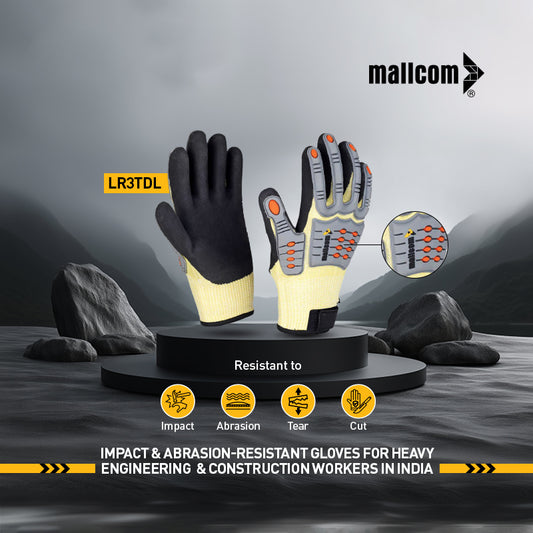
Mallcom's TM564 Impact Resistant Gloves feature a grain leather construction combined with impact protection technology. These gloves provide mechanical resistance and comfort for workers operating in heavy industrial environments.
In material handling, maintenance, and engineering operations, leather hand gloves for industrial use are the most widely chosen material for workers.
Why Choose Mallcom for Protective Hand Gloves?
The use of anti vibration gloves helps in reducing the impact of mechanical vibrations. They are designed to be comfortable and ensure effective workplace operation. Combined with suitable industrial work standards, these protective hand gloves represent a real contribution to safer workplaces and higher industrial efficiency.
Mallcom offers a large variety of industrial hand gloves for high-risk industrial sites. These include anti-vibration mechanical gloves, impact-resistant gloves, leather working gloves and industrial protective hand gloves, among others. Products such as MACH 12, MACH 22, MACH 42, MACH 43 or TM564 show how the safety, durability and performance standards required for today's workers are upheld by Mallcom to help businesses lower workplace risk and improve both their efficiency and worker comfort.
FAQs
Q. Can Anti-Vibration Gloves Prevent Hand-Arm Vibration Syndrome (HAVS)?
Anti-Vibration Gloves can significantly reduce the amount of vibration transmitted to the hands. When combined with proper tool maintenance, operator training, and regulated exposure times, they help lower the risk of developing Hand-Arm Vibration Syndrome (HAVS). Employers should view anti-vibration gloves as one component of a broader vibration control strategy.
Q. How Are Anti-Vibration Gloves Different from Standard Industrial Hand Gloves?
Standard industrial hand gloves primarily protect against hazards such as cuts, abrasions, impacts, and general wear. Anti-vibration gloves provide these benefits while also incorporating specialised materials that reduce vibration transmission. This additional layer of protection makes them particularly valuable for workers who frequently use power tools, grinders, drills, and other vibrating equipment.
Q. How Often Should Anti-Vibration Gloves Be Replaced?
The internal padding of most industrial hand gloves will compress within 3-6 months and lose effectiveness of attenuation under constant heavy usage. It may be possible that the outer shell of leather industrial hand gloves, for example, can still be structurally sound. Ensure you check the palm padding frequently, and it must be discarded if it looks compressed and has shifted, regardless of the external appearance.
Q. How Do Anti-Vibration Gloves Contribute to Workplace Productivity?
Worker fatigue directly impacts efficiency, concentration, and task accuracy. Anti-vibration gloves help reduce physical strain caused by prolonged tool operation, allowing workers to maintain better grip control and operational precision. By improving comfort and reducing fatigue, these gloves support consistent productivity throughout the workday while contributing to a safer working environment.